Wednesday, 18 July 2012

Roman Adventures Part 2

In case our brains haven't recovered from yesterday's factual overload, I shall complete my tale of my first day in Rome with slightly less history.

After rehydrating, refueling, and re-UVB-protecting, we set off down the road to the Foro Romano, or Roman Forums.

A forum was a type of plaza, which was the heart of Ancient Rome, and the Empire.  It served as a marketplace, venue for public events, and meeting place for politicians and businessmen, as well as housing some of Rome's most important and religious buildings and statues.  It evolved naturally over the years, expanding as various structures were added, which is very different to later forums which were rigidly copied from Greek plazas.


Nowadays, it is a jumble of assorted ruins and bits of marble, and almost entirely impossible to navigate.  Sadly, Italians don't seem to believe in labelling things.  However, my guidebook reliably informs me I saw some very exciting ruins, such as:


  • Tempio di Saturno (Temple of Saturn), which dates from 42AD (an earlier temple standing there from 500BC).  This was very important as Rome's early power was attributed to its success with agriculture, Saturn's particular field of interest.  He was also seen as the god of wealth, so the city's treasury was housed here.
  • Tempio di Antonino e Faustina (Temple of Antoninus and...you get the picture), built in 161AD by Antoninus for his wife Faustina.  Faustina was...er...slightly less choosy about who she lay down with, but Antoninus was besotted and seemed to be the only person in Rome who did not know his wife was a bit of a floozy.
  • Tempio di Giulio Cesar, built in 29AD on the site of Julius Caesar's cremation.
  • A 1937 reconstruction of the Curia, the meeting place of the senate.
  • Arco di Settimio Severo, an archway dedicated to Professor Severus Snape...I think.
  • The site at which 'all roads lead to Rome' actually referred to, the Millarium Aureum.  This was a monument built in 20AD from which all distances to other city's was measured.  All Roman roads across the Empire converged here (in theory).
However, my personal favourite ruins was the Tempio di Vesta and the Atrium Vestae.  Vesta was the goddess of the hearth and family, and the Vestal Virgins were her priestesses.  The Virgins were selected from the wealthiest, most influential families of Rome at the age of between 6-10, and they served for 30 years; 10 years learning, 10 years performing rituals, and 10 years teaching new Virgins.  


They had two main jobs.  The first, was to keep alive the sacred fire, which burned in the temple.  This fire was so important that is was regarded as fundamental to Rome's security and the continuation of the Empire. Any Virgin allowing it to go out would be whipped by Rome's high priest, the Pontifex Maximus.

The Virgin's second job was exactly that: to remain a virgin.  If their cherry was popped, they were buried alive, as it was sacrilege to spill a Virgin's blood.  The man who popped their cherry for them was flogged to death.

In payment for their service/chastity the Virgins had special rights within Roman society, and could intervene in sentencing of criminals (in fact, they secured a pardon for Julius Caesar when he was younger, and saved him from execution).  They had right of way on all streets, and any injury or attack on them was punishable by death.  They were paid by the state's treasury, and upon completing their service they were awarded a pension and allowed to marry.

After the Forum, we climbed the hill to the Palatine, the oldest settlement of Rome.  It is supposedly the site at which the she-wolf suckled Romulus and Remus, the founders of the city of Rome.

Romulus and Remus were fathered by either Mars, the god of war, or Hercules, that well-known Disney actor.  Interestingly, their mother was a Vestal Virgin, and had been forced into this life of servitude by her uncle, to prevent her having male heirs who could overthrow her dastardly uncle and take their place as rightful ruler the city of Alba Longa.

Whoops.

After R&R were born, their great-uncle abandoned them to die at the side of the river Tiber.  However, the river bore the twins to safety, and they ended up on the top of the Palatine hill (yunno, because rivers are well known for flowing up hills).  Here they were suckled by a she-wolf and fed by a woodpecker until a shepherd found them and took them in.  When they had grown up, they discovered the truth about their birth, and killed their evil great-uncle.

Whoops again.

However, they wanted to form their own city rather than take over Alba Longa, but couldn't decide where to form it.  Romulus wanted the Palatine Hill, whereas Remus the nearby Aventine Hill.  They quarrelled and, as so often happened in those days, Remus was killed, and Romulus set up Rome on the Palatine Hill.  Even as Rome expanded, the Palatine remained the site of the grandest and most spectacular of palaces (Palatine...Palace...you get the gist).


As a side note, myth says that Romulus and Remus were descended from Aeneas, one of the princes of Troy, who fled when the Greeks jumped out of the Trojan Horse and killed everyone.  It is this flight of Aeneas which is recounted in Virgil's Aeniad, the first example of political propaganda in history.

We managed to get quite lost in the Palatine, and couldn't work out where the exit was.  However, our increasingly fraught wanderings did lead us to some sprinklers, where we joined another tourist in an impromptu shower.  Eventually we escaped, and set off home.

For tea it was rigatori cacio e pepe (short pasta with cheese and pepper), a rather biscuit-like focaccia and gelato - our first ice cream of many.  I had pistacchio Iranicchio (pistachio and Iranians) and ciacocchio fondente (the chocolatiest substance in the world).


And so began the creation of my newest layer of stomach fat...

Tuesday, 17 July 2012

Buongiorno Italia! / Roman Adventures

Having gone literally to the other side of the world for last year's summer holiday, I decided to go a bit closer to home for my 2012 jaunt.  Hence, the beautiful country of Italy - home of pizza, pasta, the Renaissance, and smarmy Italian men on Vespa's.

Before I talk about the actual holiday, however, I would first like to mention how stressful it is to plan a holiday when you are a doctor.  First, you have to get hold of your rota for the rough time period you want to go.  Then you have to get hold of the rotas of the rest of your team.  Then you have to get hold of the rotas of everyone else on your ward, as they cross-cover when your team are all absent from the ward (annual leave, sick days, on call duties, nights, study leave, teaching etc).  Once you have identified possible dates for annual leave based on your own rota, you then have to cross reference it with everyone else's to make sure there will be adequate ward cover at all times.

The trick to this is to make sure you get your leave requests in before the rest of your team gets the chance to snatch the dates you want.  In the case of this particular holiday, there was a week of frantic texts and emails to swap an on call shift (with someone who subsequently broke his heel AFTER I'd booked the flights and accommodation, panicking me for a short while) and get everyone concerned to sign my leave forms.

You need annual leave to get over the stress of trying to organise annual leave.

So, after gaining a few grey hairs, I flew to Rome to start my summer adventure.

Most of Rome is like any other big city in Europe.  It has lots of traffic, lots of people, lots of the same high street stores, and plenty of street traders who will wander up to anyone looking vaguely touristy and attempt to sell you remarkably cheap Rolexs.  However, it is very different to any other city I've been to, as you can be wandering down a busy, shop-lined street, turn a corner and BAM!  Two thousand year old historical building.


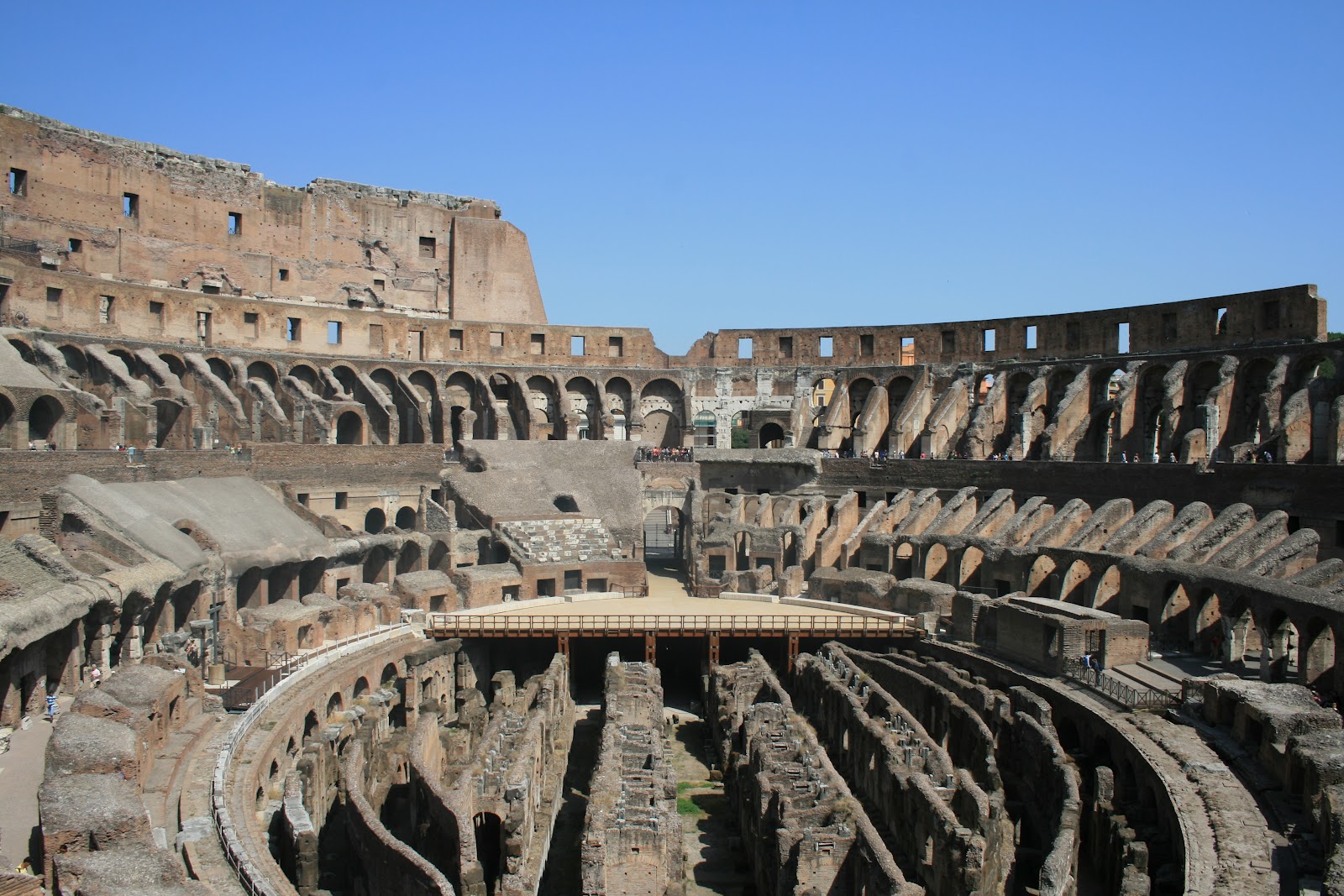
The first stop on our rather packed Rome itinerary was the Colosseum, the largest surviving structure from the Roman Empire.

The reason for this impressive feat of architecture is purely political.

Commissioned in 72AD by Emperor Vespasian, the first member of the Flavian dynasty that ruled Rome for the next quarter of a century, it was placed on the site of Nero's palace.  Nero was the Emperor before Vespasian, and is on the whole considered to have been a bad guy (if you believe all the ancient texts recovered from the period).  As well as making weak Vanilla Lattes, Nero also executed his mother, poisoned his stepbrother, and possibly started the Great Fire of Rome to clear space for his palace.  He is widely associated with tyrannical ruling and civil discontent, but he also invested in Roman culture and promoted diplomatic relationships with other nations.

After Nero's suicide-to-avoid-assassination, there was a year of political uncertainty, before Vespasian emerged as the new emperor. Then began a programme of damnatio memoriae, or 'condemnation of memory', in which Nero's name was erased from monuments, statues of him had their appearances changed to look like other people, and his palace was demolished deliberately for Vespasian's Colosseum.  Being forgotten was believed to be the worst insult possible.

One such statue is responsible for the current name Colosseum.  Next to his palace, Nero had a giant statue of himself built, called the Colossus of Nero.  When Nero died, a sun-ray crown was added and the statue converted into one of the sun god.  Over the years the head was replaced a few times to one of the current emperor, but the statue remained called the Colossus.  It was in early Medieval times that the Colosseum developed it's current name, believed because of a shortening of 'the theatre next to the Colossus'.  It is a bit more roll-off-the-tongue than it's original name, Amphitheatrum Flavium.  

Sadly Vespasian died in 79AD, before the Colosseum was finished, but the new Emperor, his son Titus, inaugurated it in 80AD with a massive 100-day games killing 5000 animals and who knows how many gladiators.  The final touches to the building were completed by Domitian in 81-96AD.

The amphitheatre was the first of it's kind in the world, and showed extraordinary engineering.  The Ancient Greeks could only build semicircular theatres into the sides of hills; the Romans could build two theatres joined together and free-standing! (Amphi = double, hence amphibian meaning double life on land and in water.)  It was made with a base of light volcanic rock and cement, and surfaces were guilded with marble held in place with iron brackets.  The marble and iron was subsequently plundered from the structure in the Medieval period, to build new monuments and melt down for weapons, respectively.


A day of games at the Colosseum followed the same order:  firstly, the animal hunts, which included animals from all corners of the Empire, some of which had never been seen by your average Roman. This was followed public executions, preceded by a nice bout of torture, and often playing out scenes from Greek and Roman mythology.  Lastly, the gladiatorial games for which the Colosseum is most well known.

A series of understage tunnels, pulleys and lifts allowed dramatic entrances of contestants and animals.  There were even aquaducts to flood the arena for naumachi, or re-enactments of famous sea battles.  When not fighting in water, the floor of the Colosseum was covered in sand to reduce slipping and to soak up all the spilled blood.  Indeed, the Latin for sand has given us the term arena to mean any site of entertainment/sport.

The Colosseum could hold 50,000 spectators, and entrance was free, with free provision of food and wine (after all, what better way to control the masses and feed political propaganda by inviting them to spectacular events?).  There are four sections of the building - the average Roman pleb sat at the top, the citizens on the next tier, the knights the next, and at the bottom the senators.  There were special sections of this tier at each end of the amphitheatre, one for the Emperor, and the opposite for the Vestal Virgins (more on these exciting ladeez later).

There were 80 exits, which are rather hilariously called vomitoria.


The Colosseum was probably used for its original purpose well into the 6th Century.  After that it was used for many purposes, including cemetary, castle and rented housing.  At one stage it was proposed to be turned into a wool factory to employ the cities prostitutes, but this never came to pass.  It sustained significant damage from centuries of fires, earthquakes, and plundering.

In 1749 the building was consecrated by Pope Benedict XIV as the site of execution of many Christian martyrs.  There is no historical evidence that any Christians were executed there, but its sudden consecrated status was the Colosseums saviour - subsequent Popes restored the building and protected it from further plundering.  A cross still stands in the arena, and this is the starting place for the Pope's annual Stations of the Cross on Good Friday.


After a guided tour of the Colosseum by a very nice Italian archaeologist who told us very little of the above, we sat in the shade of the trees now standing at the old site of the Colossus and ate a very over-priced parma ham ciabatta.  We rallied our energy, reapplied our sun cream, and moved on to the Roman Forum, conveniently next door to the Colosseum, and the subject of my next blog post.

There's only so much history one can absorb before requiring a break.

Sunday, 2 October 2011

Meze

Yesterday we went to a waterpark, then out for tea. I won't bore you with the details of the water slides (most of them went something along the lines of: weeeeee-splash), but I will describe to you exactly what a Cyprus meze involves.


Meze is short for mezedes, which means 'little delicacies', and was brought to Cyprus by the invading Ottomans. I have already had meze a few times at Greek restaurants in the UK, but nothing could have prepared me for this experience. Our waiter, Kivros, brought out each dish one at a time, and refused to bring the next one until we'd finished the plate in front of us.


So, here are the dishes, in the order we were brought them:


  • Olives
  • Salad
  • Pickled vegetables
  • Tzatziki, tahini and yogurt
  • Toasted bread
  • Halloumi in pitta
  • Lountza (smoked loin of port) and loukaniko (a type of sausage)
  • Saganaki (a method of cooking with one frying pan) with feta, tomato and oregano
  • Lamb kebab
  • Chicken kebab
  • Sheftalia (another type of sausage)
  • Fresh ravioli
  • Pork ribs
  • Potatoes fried with eggs, halloumi and pork loin
  • Courgette fried with eggs and onions
  • Pork fillet with oregano
  • Aubergine in batter
  • 'Marrow' – according to Kivros, but it was like a falafel made with courgette instead of chick peas
  • Honey-soaked dough balls


After this feast we were served Greek Cypriot coffee and coffee liqueur. If Turkish coffee is like being punched in the face, this is like being lightly tickled on the cheek with a feather. Which is good as it was bedtime by this point! Again, you have to specify how much sugar you would like: glykos (very sweet), metrios (medium-sweet) or sketos (unsweetened).


After this it was time to go home and lie down in a cold room.

Thursday, 29 September 2011

Optimistic attempt at uploading photos...

Ancient Salamis: The columned courtyard


Ancient Salamis: a fresco over one of the baths


Ancient Salamis: the amphitheatre


Famagusta: Lala Mustafa Paşa Mosque


Famagusta: Turkish coffee and baklava


Famagusta: Turkish delight


Home: Nelson, the one eyed cat


Naked Romans dripping in oil...

Yesterday we went back across the border to visit Salamis and Famagusta again.


The road to Famagusta is an interesting one. It runs along the Green Line, and so most of the journey was spent staring at the no-mans land on our left. The line itself is not demarcated by fences or walls, which seems unusual as no one crossed it for 29 years. This is because after the ceasefire line was drawn both the Greek and the Turkish Cypriots laid down extensive landmines along its length, as this is cheaper and more practical than building a giant fence and manning it every few metres. Thus Cypriots were discouraged from crossing.


Along its length you can see Turkish outposts, which are painted completely in patches of red, green, yellow and black paint. But they don't look as comical as the UN outposts, which are basically just one-man huts on top of giant sticks!


We crossed over the border again, and I got my first experience of driving in North Cyprus. It's...interesting, lets say. It's like driving through Rusholme on a Friday evening. Road traffic rules do not seem to apply at all, so it was a little stressful!


We made it in one piece to Salamis, however, and parked up by the sea.


The ancient city-kingdom of Salamis was founded around 1100 BC by the Homeric hero Teucer, who fought in the Trojan War. He was exiled from his homeland by his father, the king of the Greek island Salamis, for not avenging the death of his brother, Ajax. Instead, he came to Cyprus, and set up the city of Salamis.


Over the years, despite being ruled by many different parties, same as the rest of the island, Salamis grew wealthy, due to its prime position for sea trading. But it was in the Roman era that Salamis really prospered, and it was during this time that much of the building work was done.


In 674 AD, however, Arab raids brought about destruction of the city, and the residents fled to what is now Famagusta. There then must have been an impressive change in climate, as the whole area was flooded with sand, until only the tops of the columns peeped above. This did stop some of the destruction by natural forces, but unfortunately did not stop the looters. The area was extensively looted until 1952, when the Department of Antiquities began excavations. These stopped between 1974 and 1998, when international sanctions prevented excavation parties going into Northern Cyprus.


So, what is there left to see in Salamis? Lots! The ruins we see today are from the Roman period, some of which were rebuilt by the Byzantines after the earthquake of 331 AD.


The first area we saw was the latrines, which catered for 44 people at a time! Imagine the smell... Then we walked out into the columned courtyard, a spectacular gymnasium surrounded by huge columns. This was built in 76 AD, but was largely destroyed by the 331 AD earthquake. When the Byzantines rebuilt it, they dragged columns from other areas of Salamis, not caring if they matched or not, so the columns we saw were all different sizes and styles.


Around this area are many headless statues. They are headless because when Christianity was adopted as the official religion, these Roman symbols were abhorrent to them, and they broke off all their heads.


Of course, this prompted many photos of me and Bernie pretending to be headless statues.


Around the courtyard the Roman's obsession with baths became apparent. There were hot baths, mild baths, and cold baths, some with elaborate multicoloured sides and complicated under-floor heating systems. This was where the Roman warriors went to relax after a hard day wrestling each other naked covered in olive oil.


We also saw an impressive amphitheatre, which has been partially restored to 18 rows of seats (originally it had 50 rows). It was here that we pretended to be headless. We also saw: sweating rooms, stoking rooms, an aqueduct, Byzantine walls, and a (very straight) Roman road.


Sadly, we didn't get to see the mighty Temple of Zeus, as it was too warm to walk the 3km down there. The thermometer in the car said it was 38º, but I don't know how reliable that is. Much more reliable, however, is the Ashlea-ometer, which measured the temperature as 'Too Frickin' Hot'.


After a quick cold-drink-and-factor-50-suncream stop, we headed back down the road to Famagusta. We had a picnic in the shade of a tree, then wandered around the walls of Famagusta.


Under Venetian rule Famagusta had great wealth, and impressive churches and walls were built. The city is surrounded by these walls, which are up to 8m thick in places. Unfortunately these great walls did not keep the Ottomans out, and much of the walls, bastions and churches were blasted with cannonballs. They have never been rebuilt, so ruins are just scattered about the modern day city.


The most interesting thing about Famagusta, however, is that it is supposedly the city in which Shakespeare's Othello is set. This is based on the stage instruction from the play 'a seaport in Cyprus'. Also, the description of Othello as being a moor may be a misunderstanding on Shakespeare's part, as he never went to Famagusta. The Venetian ruler of Cyprus in 1506-08 was called Christoforo Moro, whose surname means 'Moor', though he himself wasn't a moor.


The second most interesting thing about Famagusta is Petek's Patisserie. I said in the previous blog I would talk about the treats today, and here we go.


Turkish Coffee

Taking a sip of Turkish coffee is like being punched in the face. Its rather extreme potency comes from the preparation process. First, one teaspoon of coffee is boiled in one cup of water in a small long-handed pot called a 'cezve' until it froths up. A small amount of the froth is then poured off into the cup, and the cezve is returned to the heat. It is boiled again, and then served.


When you order your coffee you have to specify how much sugar you would like: çok şekerli (with sugar - 'sweet as love'), orta (medium-sweet), or şekersiz (unsweetened - 'bitter as poison'). As it is so intense it is served with a carton of water, to prevent the inevitable dehydration.


Baklava

Just one word – amazing! I don't even like honey, and I gobbled my portion down pretty damn swiftly, and returned to buy more to take back to the UK (fortunately everywhere in Famagusta accepts Euros as payment, performing a rather informal 2:1 conversion from Turkish Lira for us).


Turkish Delight

I do not like the Turkish delight I've had in England. Especially the rose flavoured stuff, its pretty revolting. However, the counter at Peteks is a smorgasbord of brightly-coloured, coconut-covered cubes, and I couldn't resist. They have pieces containing hazelnuts, pistachios, even carrots! And it tastes nothing like that gelatinous rubbish we have at home.


I wish I could show you pictures of all the exciting things I've seen/eaten, but sadly it is not to be :(


In other news, North Cyprus is the only country I've been where homosexuality is illegal. Attempted to look straight for the visit but probably failed miserably.

Tuesday, 27 September 2011

Famagusta, and a nice history lesson for you all.

I arrived in Cyprus just after a big thunderstorm, so the air was hot but not heavy. My first impression was that Cyprus is very beige. Everything is beige – the dirt, the buildings, the roads...


Actually, I tell a lie. My first impression was that Cyprus is so very Anglicised. The first advert I saw upon leaving the aeroplane was for TGI Fridays, and it detailed all the different branches in Larnaca. Helpful information for the majority of Brits on my plane, but the likelihood of me ending up in TGI Fridays in Manchester is minimal, let alone on foreign lands.


Anyways, I soon got over the Englishness and the beigeness, and we went to Bernie's house. I shall talk about that in a later blog.


Yesterday we had a nice relaxed day – we got up reasonably early as we had to pick up Bernie's friends from the port in Larnaca. This involved me driving Bernie's mums car.


Automatics really are the way forward. Just a stop pedal and a go pedal – it's like go-karting! Fortunately in Cyprus everyone drives on the left like in Britain, but all the speed limits are in kilometres. Helpfully Bernie's mum has written a conversion chart on the dashboard in tippex to avoid confusion.


After collecting Bernie's friends, we went back home and caught up on their travels. They had recently cycled from London to the Middle East, over a period of about six months, and are now making their way back home. They have spent the majority of this time camping or sleeping rough, so we spent most of the day providing food, running water, washing facilities and tobacco. We did go for a nice swim in the Mediterranean, but due to my true Anglo-Saxon heritage (i.e. a ginger mother) I had to dodge the carcinogenic rays with a UV top, and probably looked quite ridiculous to the two olive-skinned Cypriots we were sharing the beach with.


I tell myself I'm an 'English rose', rather than just pasty.


Today we took our cycling friends to Famagusta, where they intended to get a ferry to Turkey. To make sure everyone understands the events of the day, first I shall give a brief (and probably incorrect and naive) recap of recent Cypriot history.


The Ancient Greeks invaded Cyprus around 1200 BC, and the island prospered. Since then, Cyprus has been ruled by: Assyrians, Egyptians, Persians, Egyptians (again), Romans, Egyptians (again again), Romans (again), Byzantines, Arabs, Byzantines (again), the English, the French, Italians, the French (again), Italians (again), Ottomans, and the British in 1914. The British had been responsible for the administration of the island since 1878, with the Turks maintaining ownership, but as Britain and Turkey found themselves on opposing sides with the outbreak of the First World War, the British assumed sovereignty of the island.


The Greek Cypriots originally welcomed British rule, as it was generally assumed they would promote enosis, union with mainland Greece. Indeed they did try to do this in 1915, but Greece rejected the terms.


In 1960 Cyprus gained indepence from Britain. Under this agreement, Cyprus was prohibited from attemping to unite with either Greece or Turkey, and the British retained control of several areas for military purposes, due to Cyprus's strategic position near the Middle East. However, the Turkish Cypriots, an ethnic minority, became increasingly uncomfortable with the threat of being forced into enosis with Greece, and the early 1960's were marred by violence and political difficulties. In 1964 the violence was such that the UN had to deploy troops to help the British forces maintain peace. The Major General used a green pencil to draw a ceasefire line across the capital city (and later the rest of the island), and 'The Green Line' was born.


The state of affairs in Cyprus continues to deteriorate over the next few years, until the Turkish army arrived in 1974 to take control over North Cyprus. The Greek Cypriots who lived in the north third of the island fled to the south, and similarly the Turkish Cypriots in the south fled northwards. Many were caught up in battle and died. After that, the ceasefire line divided the island wholly, and no one crossed from one side to the other in 29 years. South Cyprus (the Republic of Cyprus) became more Hellenised, and North Cyprus became almost completely Turkish.


In 2003, however, the first step towards a more unified Cyprus occurred. The president of North Cyprus (known by the Turkish as the Turkish Republic of Northern Cyprus(TRNC), and by everyone else as the occupied territories) opened the ceasefire line to travel, allowing people from both sides of the divided capital to cross to the other, as long as they were back to the own side by the end of the day. The Greek government were taken completely by surprise by this amendment, and no one knew how the Cypriots would react. After all, many still had family and homes on the other side of the line that they had not seen in 29 years.


The answer was: the Cypriots did not react. Thousands upon thousands crossed the border in the next few weeks, visiting their old houses and walking around the places that were so familiar to them. The two populations were friendly, exchanged gifts and tears, and since then there has been no major incident. The border is now open to crossing in six places, and Cypriots can now cross for three months at a time. The UN still maintain a presence along the line, and will until reunification is achieved.


And so...back to the events of today.


Famagusta is in North Cyprus, so we had to cross the Green Line to get there. On the way we saw the ruins of Marąs, a deserted town on the border. Pre-1974 this was a prosperous town inhabited by many Greek Cypriots who worked in Famagusta. However, when the Turkish army landed, they had to flee the area in such a hurry that there are still plates on the tables with breakfast foods on them, light bulbs still switched on, curtains blowing in the wind. Since then, no one has been back, and Marąs remains a ghost town.


After Marąs came several Turkish outposts, with the red and white Turkish flag and the white and red TRNC flag flying proudly. Then came the Agios Nikolaos Crossing.


Manned by Greek soldiers on the South side, followed by a small stretch of road then Turkish soldiers as it goes North, the area is studded with customs officers and signs warning of crossing without the correct documentation. We had to purchase additional insurance to allow us to drive in the North, and then we got our Turkish visas. The border guards stamp a piece of paper that is not included in your passport. This is because if you tried to enter South Cyprus through another way, e.g. flying into Larnaca airport, you would be detained and heavily questioned if you had a Turkish stamp in your passport.


After having your passports and visa checked by both Greek and Turkish border guards, we were in North Cyprus.


Since the division in 1974, the South prospered from tourism and entering the EU, but the North trailed behind significantly. However, the Turkish economy is picking up, and the GDP of the TRNC is now around 50% of that of the Republic of Cyprus. As such, Famagusta is still a tourist attraction but does not have that 'Brits On Tour' feel that Larnaca does, and the tourists we saw were mainly American or other nationalities.


I, however, looked touristy enough to represent the whole of Britain, with my white, white skin and my giant camera.


Under Italian rule Famagusta prospered, but invading Ottomans laid waste to the city. Much of the crumbling Venetian walls still remain, however, and we wandered around the remnants of the fort for a bit. We also saw the Lala Mustafa Paşa Mosque, a very impressive building that was built as a church in the 1200's but during the Ottoman seige the two towers were destroyed. It was then converted into a mosque, and they added their own minaret.


Unfortunately the internet connection here doesn't seem up to loading photos, and it just gets stuck on 13%.


After a bit of wandering we settled down in Petek's cafe and had some treats, but I will not disclose too much about this today. Tomorrow we are going to drop in to Famagusta on our way slightly further north, and I will talk about the treats then. For now, I shall go to bed, as the heat is rather exhausting.

Sunday, 25 September 2011

Εγώ θα Κύπρος σήμερα / Ben bugün Kıbrıs'a gidiyorum

Today I go to Cyprus, yay! Hence the Greek and Turkish blog title (not taking sides is key to personal safety, according to my guide book).

Due to the resounding success of the New Zealand blog (i.e. praise from my grandma) I have decided to resurrect it for my holidays in Cyprus. This means you will all be forced to learn facts and read my inane ramblings once more.

I am currently sat in the Burger King at Manchester Airport. This is not my usual habitat, but I have a bad mouth ulcer over my wisdom tooth, and have to apply Bonjela at regular intervals (other anaesthetic gels are available). I fear the more upmarket places might frown on my sticking my finger into my mouth and dribbling everywhere. So Burger King it is.

It's like an episode of Benidorm in here.

Soon I shall board the plane and five hours later I will be picked up from Larnaca Airport by my good friend Bernie and her mum. Then my Cyprus adventures shall begin!

I know you are all desperate for my next update...