Wednesday, 27 April 2011

The Quest

Bright and early (6:30am) tomorrow morning we embark on The Quest.

This is what we are calling the road trip, as you guys failed to come up with useful and hilarious-in-a-British-humour-kind-of-way titles. No offence to those who submitted suggestions. So, 'The Quest' is it.

The capitalisation is compulsory.

This means no blogs for 10-12 days, unfortunately. I'm really sorry, please don't get too suicidally upset by the absence of my hysterical writings. I'll be too busy having Fun (also capitalised) to blog.

However, I will leave you with the Doctor Who plot my grandma helpfully compiled from the list of things involved in The Quest:

'In period dress, the Doctor and his companion travelers are captured by sea creatures who live under the polar icecap of a distant planet, where the only light is from the innumerable number of stars that shine constantly with light so powerful that it penetrates through the ice. The Doctor and etc eventually overcome the creatures by using a cunning plot and escape by using a boat made of ice, which eventually reaches the surface of the icecap and they return to the Tardis.'

Yep, Grandma Dragon, that's exactly what it's going to be like.

Freddy's Ice House

Tonight we went to an ice bar.

This is a bar made of ice.

The walls are ice.

The tables are ice.

The chairs are ice.

The glasses are ice.

You get the picture.

Pretty much the only things that aren't ice are the floor and the drinks. We turned into ice after an hour in the bar.

It was quite an odd place. First off, you weren't allowed to take pictures - instead they would take pics with their own cameras and then you had to buy the prints. Second, they gave you latex gloves to put inside the snow gloves. Lastly, it is basically just a walk-in freezer with house music blasting out the speakers.

After two cocktails we were pretty chilly, so we went to another bar to thaw. This was also odd - it was a typical sports cafe, but half the room was set up as a bookies and the other half was showing televised chariot racing.

Monday, 25 April 2011

Easter Film Review

Well, after failing to do sitting down things on Good Friday, I tried harder for the rest of the weekend. This time I succeeded! So here is a run down of the weekends films:


1) Lord of the Rings: Fellowship of the Ring : ****
Dumbledore and some fellas of varying heights roam the New Zealand countryside meeting elves, fighting orcs, and generally having a good time. Sure, there is some mean bloke trying to destroy their homes and enslave them, and the vertically challenged ones are permanently on the brink of tears, but overall it's a feel-good romcom. The best bit is when Dumbledore shouts 'YOU SHALL NOT PASS' and then 'dies'.

Morals of the story:


2) Lord of the Rings: The Two Towers : ****
See above.

Morals of the story:
  • Never enrage a giant tree.
  • Tossing a dwarf is acceptable in the midst of battle.


3) I Love You, Man: ***
Man is getting married, but has no friends to be his best man (why he couldn't ask his brother I have not worked out. Probably because then there would be no film). Goes speed-dating and makes a friend, but the friend is a tad childish and causes friction between Man and his fiancée. There's a lot of air guitar, jokes about Lou Ferrigno, and an awful lot of swearing considering it was being broadcast at 2pm. In the end, it all works out fine: he gets the girl, he gets the friend, and even the dramatic gay man is happy.

Morals of the story:
  • It's bad to laugh at people (read: Americans) who spell Zoe 'Zooey'.
  • Don't name your dog after dead Egyptian presidents, as you will get sued.


4) The Matrix: **
Keanu Reeves takes a break from looking sad to discover the world is a computer program. Actually, this was before he was sad, but as this world is not real it doesn't matter what order I say things happen. Anyway, Keanu busts out of the program, where he had a nice cushy life, to the real world, where he is hunted and suffers a fair bit. Silly man.

Morals of the story:
  • There is no spoon.


5) Public Enemies: ****
Man robs bank. Man gets sent to jail. Man escapes. Man robs bank. Man has intimate relations with Woman. Man dies and Woman gets sent to jail. The End.

Morals of the story:
  • Just say no.


6) Shrek: ****
It had been so long since I'd seen the original Shrek that I'd forgotten a lot of the jokes, which was nice. Shrek is an ugly ogre, who goes to save a princess trapped in a castle. But, the princess has a secret *gasp* - she is also an ogre! Well, only at night time. Then she looks like half the drag queens down the gay village on a Friday night. She eventually comes to realise that Shrek is her true love, and they get rid of Lord Shortypants and live happily ever after. Unfortunately, there are no dragon-donkey-babies in this film *sad face*.

Morals of the story:
  • Princesses can explode birds with the power of their voices. Beware.
  • Inside every dragon is a beautiful woman just waiting to be loved.


7) Hot Fuzz: ***
Simon Pegg is a super duper policemanofficer who gets sent to a quiet country village when he gets promoted. He meets Nick Frost, who is another policemanofficer, and they become best buds. But then, Simon Pegg uncovers a dastardly ethnic cleansing programme going on in the village, and disagrees on moral grounds. So he shoots the lot.

Morals of the story:
  • Chunky Monkey is the standard punishment for drink driving.
  • You can take on most organised crime rings if you have aviators, ketchup and a sea mine.


8) Valentines Day: ***
Star-studded romcom (compare and contrast: Lord of the Rings Trilogy) full of heart-warming story arcs that go a bit like this: boy meets girl. Boy finds out girl is an Adult Phone Entertainer. Boy has a bit of a paddy, but the girl has fallen in love with him after like, two dates, so they are fated to be together for all eternity. It's a bit like a bad American version of 'Love Actually', but in this one the cute kid is in love with his teacher, which is a bit creepy.

Morals of the story:
  • In fact, this whole film is one long moral. Think of all the morals you could fit into a film about love, and you've just about got it.


So, there you have what I got up to this Easter weekend.

And now, it's time for me to ask for a little help from you guys back home. On Friday me and three others are going off on a ten day trip. However, we want to call it 'A Quest For...' but have not come up with a good thing to be questing for. Any ideas? The trip will include:
  • Ice.
  • Sea Creatures.
  • Boats.
  • Stars.
  • Period dress.

Answers on a postcard/email please!

Friday, 22 April 2011

Goat Island

As we are embarking on The Mammoth Road Trip of FunTM next weekend I thought it was a sensible idea to have an expense-free weekend doing mainly sitting down things.

Instead, I went snorkeling. Sensible behaviour is for grown-ups.

Myself, the other DrA, and DrC, set off in our rental car (a much much smaller car than the previous one) for Goat Island Marine Reserve.

Goat Island Reserve, or Cape Rodney-Okakari Point Reserve (much less catchy), is New Zealand's first marine reserve, created over 30 years ago. The name Goat Island has a quite interesting origin. Back in't day when there were loads of seafaring type folk, people were quite scared of running aground on some desolate piece of coast with nothing to eat for miles. They introduced livestock everywhere they went, so they would have food. However, there wasn't much point introducing them on the mainland, where they would just disperse, so they introduced them on islands easily accessible from the mainland. If the island had a source of fresh running water they introduced cows and sheep, but if there was no fresh water they introduced goats. This is because goats are so frugal with their water metabolism that they can survive on a diet of just foliage without any water. In fact, there are about five Goat Islands in New Zealand.

Pigs were not used, as they have an inconvenient habit of swimming to the mainland.

Goat Island became a marine reserve because of its clear water and open exposed coast. According to Wikipedia, a marine reserve is just a patch of sea that is protected from fishing or development. I was envisaging underwater fences.

Anyway, we arrived at Goat Island, and rented our snorkeling gear - wetsuit, flippers, mask and snorkel. Here are the two DrA's looking like a very attractive duo:


I was quite offended by the snorkel gear-woman judging me to be a size 16.

We then set off to snorkel. Technically my camera is waterproof to ten metres (which means ten metres below the surface. When I was a kid I thought it meant you could only swim a distance of ten metres before it would be damaged. I was very confused by what would happen if you just stayed still), but I didn't really fancy trying it out when I can't afford to buy a new one.

At first, I kept forgetting to breathe, and just popping my head above the surface and taking big gasping breaths. Then I remembered the purpose of the snorkel, and managed to force myself to breathe through it. I was still breathing like a smoker of 40 years having a panic attack though.

We saw lots of fish. It was great! There was one enormous Snapper that kinda appeared from underneath me and made me scream, but the rest were pretty cool. There were some nice glowing blue ones, and some pretty ugly frilly ones. Nearer to the coast we got caught up in a shoal, and they were so close we could have easily touched them. We kept our arms firmly by our sides, though, as they were pretty scary. They were definitely watching us, and everytime we thought the shoal had gone away, we'd turn round and they'd all be behind us, staring at us. It was an amazing experience.

Here is a picture of the reserve:


You can just see a rock in the middle of the sea, in the far left. This is called Shag Rock, pronounced 'Shay-g'.

After getting changed and trying to tame our hair, we decided to go for lunch. Fish and chips. Yep. It was yummy.

Nearby is Tawharanui Regional Park, so we decided to go there as we'd heard it was very pretty. We went to a part of it called Anchor Bay, and were rewarded by the clouds moving away and the sun coming out for the first time that day. Anchor Bay was very nice, but the best bit was when I rounded a corner and ended up on a massive beach all by myself. It was incredible. The low sun did pretty amazing things with the light:


I also saw these very odd structures made of sand on top of a rock:


After that we decided to go home. However, there was a slight problem:


The sheep did eventually disperse, and we went home to go to a Chinese restaurant. You may have noticed we are trying to eat every Far East cuisine during our time in NZ. So far we have tried:
  • Japanese - £7.50
  • Korean - £6
  • Malaysian - £12.50
  • Chinese - £5.90
Next time: Vietnamese.

After tea we went for a late night drive, as the other DrA had put too much petrol in the rental car. We went to Mount Eden and Mission Bay, but I won't tell you about them as I'm going to go in the day at some point.


EDIT: I forgot to mention The Toll Road Incident.

On the way to Goat Island there is a toll road. The car rental man told us you had to go into a BP garage to pay the $2, but that it was well signposted.

It wasn't.

We ended up on the toll road, driving past loads of signs saying 'NON PAYMENT IS AN OFFENCE' in big letters, but no idea how we were meant to pay. Finally we saw a sign with a phone number. Apparently our car had already been flagged up as not having paid, but they let us pay over the phone. Phew!

Silly JAFA's (Just Another...Friendly...Aucklander - their nickname given to them by the rest of New Zealand)

Monday, 18 April 2011

Waitomo Caves - Road Trip Day 3

After another surprisingly good sleep (and a rather...bracing...shower) we headed off to the Waitomo Caves, travel sickness in full force again.

Waitomo (wai meaning water, tomo meaning sinkhole) is a village with a population of 41, and home to an extensive cave system. The area, made predominately of limestone, lies on a fault line, and you can see the differences in rocks on either side as you survey the scenery.

There are several companies providing tours and sports experiences in the caves, but we went for the less publicised one as it provided smaller group sizes and more time in the glowworm cave.

Our tour started with a nausea-inducing drive to the first cave. Our guide was a very nice man called Norm, and he provided us with lots of information about the surrounding area and the history of the caves. He also named us 'Team Doc', which was nice.

The first cave we went to was called 'Te Ana o te Atua' ('The Cave of the Spirit), and had some pretty spectacular stalactites/mites etc.


Norm was very informed and told us about the different processes that led to the formations. We also saw bones of animals that had died in the cave (when they set up the tours they didn't change anything about the caves, only installed a walkway), including a skeleton of a moa, a giant flightless bird that was hunted to extinction by the Maori people centuries ago.


This is Team Doc in the first cave:


The real excitement, however, was in the next cave. After a cup of coffee and some tasty biscuits, we were given helmets with lights on the front, and led into the next cave. This was a bit scary, as we kept the lights off for most of it to develop our night vision. This was because 10 minutes into the cave was a boat, which took us on a voyage through a passage full of glowworms.

The glowworms, or Arachnocampa, are the larvae of a fungus gnat. After hatching from the egg, a larva spins a nest out of silk. Then it creates up to 70 threads of silk from the nest, each around 30cm long and studded with drops of mucus. A chemical reaction in its abdomen causes the worm to glow, which attracts prey such as flies. The prey then gets caught in the strings of silk, and the worm detects where the fly is by the vibrations of the strings. It then pulls the string up and eats its prey. If food is scarce they sometimes resort to eating each other. Glowworms can only survive in places without wind (or their strings would get tangled), which is why they live in caves.

It is difficult to describe the sight of millions upon millions of little blue-white points of light on the ceiling of a cave. As our eyes adjusted to the dark more and more glow worms became apparent, and it became even more stunning.

It is very difficult to photograph glowworms; we couldn't use the flash as it would disturb our night vision, and you wouldn't have been able to see them anyway. However, the lovely tour company people emailed us some photos:


That was nice of them.

On the way out of the cave we encountered a cave weta. This is a horrific insect that looks like a spider. It was easily bigger than a acromegalic hand. I was traumatised and squealed a bit.

After the tour (which surprisingly took over three hours) we headed back to Auckland. This was the longest journey (at about 2hr 45mins) but was mostly straight roads, so I didn't feel too bad. The rest of the evening was spent moaning about the scent of sulphur and hangi lingering in our clothes.


Rotorua - Road Trip Day 2

After a surprisingly good (if hot and stifling) night's sleep, we set off for Rotorua on Saturday morning.

We had initially been encouraged by the car rental man telling us we couldn't get lost because there aren't many roads. This was partly true - the bit about the not many roads anyways. The problem with not many roads is there aren't many road signs; you can be driving down a state highway for an hour before discovering you're going in the wrong direction.

This happened to us.

And it was windy mountain state highway too, so I was about to throw up on everyone.

After a brief travel sickness-induced stop in somewhere small and unremarkable, we got to Rotorua just after lunchtime.

Rotorua is a city on the banks of a lake of the same name. Rotorua comes from the full Maori name 'Te Rotorua-nui-a-Kahumatamomoe', which translates as 'the second lake of Kahumatamomoe' (roto meaning lake, rua meaning two). It was the second lake discovered by the chief of the Te Awara tribe (mentioned in my previous post - they get around), and he dedicated it to his uncle, Kahumatamomoe. Presumably he was a pretty nice guy.

Rotorua's other, informal name, is Sulphur City. This is because the whole place stinks of sulphur, due to the geothermal activity in the area. There are numerous hot springs, geysers, and bubbling mud pools in the area, so we decided to go see some.

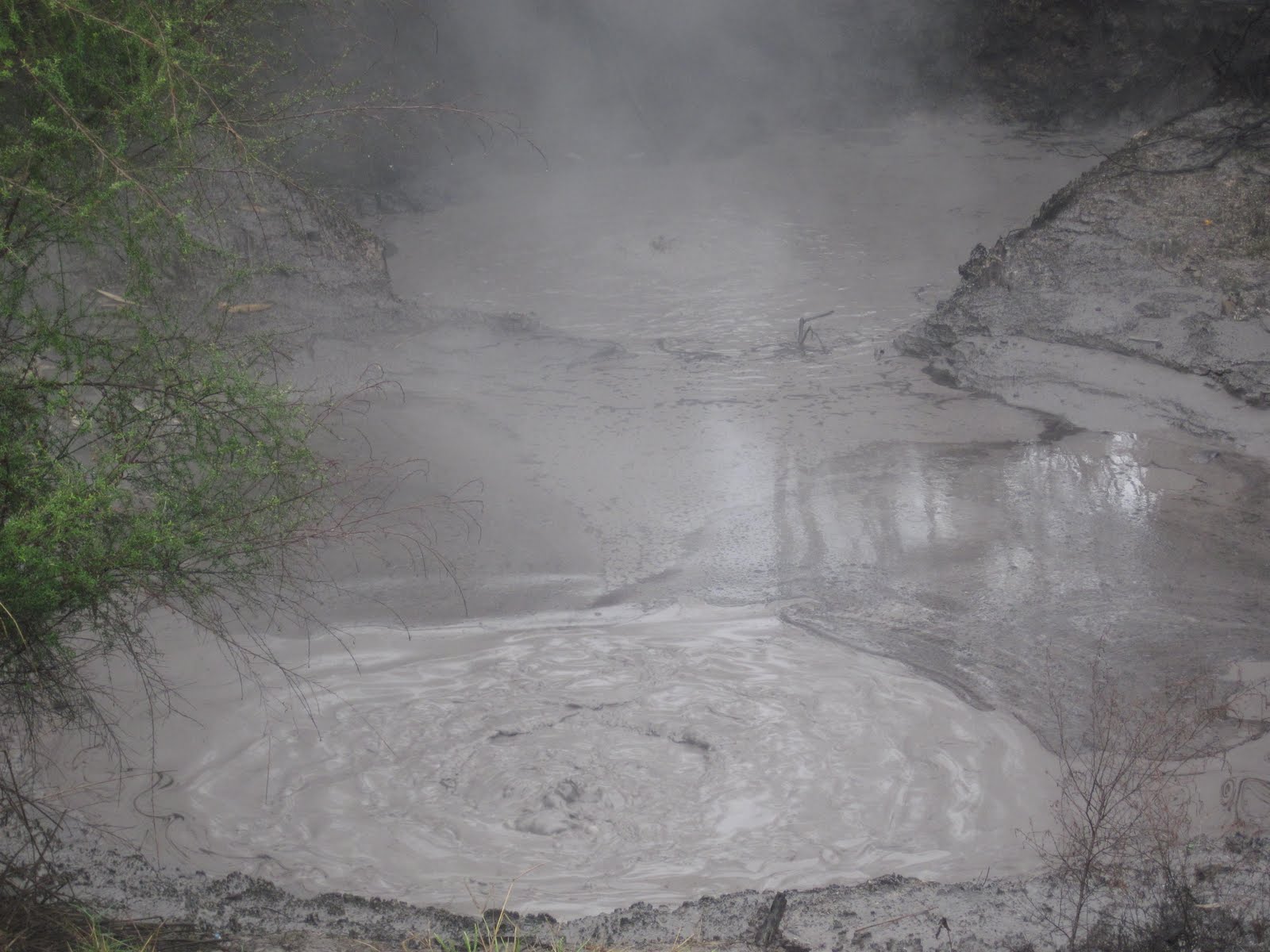
Unfortunately the best geothermal sights are a little way out of the city, so we had to make do with visiting Kuirua Park in the centre as we were pushing for time. This park has bubbling mud pools and steaming hot springs dotted around, and so when the wind is blowing towards you you can get a pretty noxious gas cloud in your face. There are also hot spas for dipping yourselves around the park too.

Here is a bubbling mud pool:


After this we went for a late lunch (Japanese - nom) and then me and DrC headed back to our slightly bigger six person bedroom for a nap, as we were KOed from the travel sickness tablets.

In the evening we went to a Maori village for a cultural evening. We were picked up from our hostel by a driver and taken to the office. We were instructed in how the evening was going to pan out. We were to be members of the 'Huia' waka (canoe). Our waka looked suspiciously like a coach, and handled pretty well on roads. Our driver was named Wati, and he was pretty insane. On route to the village he chose our ariki (chief), who was called Darren, from Australia. We did some grunting to show we were rowing our coach waka, and then arrived at the village.

Before we could enter the marae (sacred place) the Powhiri, the formal welcoming ceremony, had to be performed. A series of intimidating haka (dances) were performed by members of the tribe, and then the chiefs had to accept the teka (peace offering) to signify their peaceful intent. There was then some more singing and dancing, and we were allowed into the village as 'tangata whenau' ('one of our people').


I am glad only men could be the chiefs, as the haka were pretty scary.

In the village, we walked around different huts and learned about different parts of everyday Maori life. For example, before Westerners arrived in Aotearoa they had no written language, so they told stories and recorded information by carvings on doorframes and decorations. They also had no metals, so they did this all using bone chisels.

It was actually their lack of metals that made the Maori people welcome the British with open arms originally, as we gave them muskets so they could fight their rival tribes.

They also didn't have alcohol or drugs. We helpfully gave them those too.

After learning about such things, we went to observe the lifting of the hangi meal. The hangi is a pit in the ground, in which white hot stones are placed. Baskets of food are then placed on the stones, sacking (they used to use leaves and bark) is placed over these, and dirt is piled on top to seal it off. It is then left for several hours. Here is one hangi being opened:


The wellies are not traditional Maori dress.

While the rest of the hangi was being prepared, we went to the Wharenui, which is a sacred meeting house, to experience some Maori song and dance. This was very lively and energetic, and each song seemed to hold some significance in Maori culture. They performed the haka used by the All Blacks at the end, and it was very powerful. There was also one very attractive warrior wearing just a loin cloth and traditional tattoos, which was nice.

After this, it was time for our hangi meal. This means I am going to have to discuss the food in this post, and not in a 'New Zealand Foodstuffs Part ?' post. My inner autistic child is quite disturbed by the break in continuity.

The method of cooking the hangi gave everything a very distinct smoky taste. It was not unpleasant, and I easily put away two plates of grub, but I don't think I'd have another one. They also provided gravy and cranberry sauce with the meat, which I'm not sure is very traditional.

After the hangi it was home time, and Wati drove our coach waka back to our hostel. It was this drive that showed us he was insane - he drove round and round and round and round a roundabout singing the whole of 'She'll be coming round the mountain'.

Overall, the evening was very fun and enjoyable. I did feel a bit uneasy for a lot of it though, as I was very conscious of the fact that it was a 'cultural insight' aimed at Western tourists, and I felt a bit like I was offending the Maori people by reducing their culture to a tourist attraction just by being there. This was probably misplaced guilt over the fact that the British oppressed the Maori and took away their ancestral land, as the workers at the village seemed proud to be sharing parts of their culture with us, and wanted us to learn and appreciate their way of life.

After that, is was another interesting sleep in a six bed room, but this time it smelled of rotten eggs.


Sunday, 17 April 2011

Coromandel Peninsula - Road Trip Day 1

This weekend we decided to go on a road trip. The first stage was figuring out the different NZ road rules. Fortunately, it is pretty similar, though there is one big difference that catches a lot of UK drivers out. NZ treats every uncontrolled junction like a roundabout; i.e. you have to give way to the right. So, if you're driving down the road and want to turn left into a side street, but someone on the other side of the road wants to turn right into the same side street, you have to give way to them.

Once we had cleared that up, and after mistakenly indicating with our windscreen wipers a few times, we set off in our enormous 8 seater car to the Coromandel Peninsula.

It was a two and a half drive to where we were staying, and the first half went really well. We stopped off in a town called Thames, as there was a shop selling award winning pies. Thames is an old gold-mining town that nowadays seems to trade predominantly in alcohol and cars. It was a pretty dull place, though it did have New Zealand Skinniest Furniture Store, and a museum devoted entirely to drinks cans.

After lunch, we drove through the Coromandel mountains. The road clung precariously to the sides of the mountains, occasionally going up further or descending down into the valleys, making our ears pop. The scenery was amazing...or so I'm told. It was about this time I discovered I have not got over my childhood travel sickness.

Winding mountain roads at 100kph = very nauseous DrA.

Finally though, we arrived at the turning for our accommodation, and promptly drove right past it by mistake. Instead we went to Cathedral Cove.

The Maori's call Cathedral Cove 'Te Whanganui-A-Hei' (The Great Bay of Hei), after a priest from the Te Arawa tribe who claimed ownership of this area by proclaiming it 'Te Kuraetanga-o-taku-lhu', which translates as 'the outward curve of my nose'. It was used in the latest Narnia film, which is exciting.

It is a very beautiful place, with a massive stone arch formed when two caves on either side of a cliff joined together. There is also a giant rock in the middle of the bay that has been worn away over the years, and a natural waterfall. Here are some pictures, that will look much better once I've touched them up on my home computer:


I didn't manage to convince the others to go swimming (they said they 'hadn't brought their costumes'. Pathetic excuse) so I had to go by myself. It was five minutes of half fun, half fear. They were no where near the biggest waves I've ever swam in, but the unpredictable directions and close proximity to rocks/cliffs made it pretty interesting. Got rid of the travel sickness though.

After Cathedral Cove, we headed back to the accommodation (me sat on a plastic bag in the car, as I had gone swimming in my shorts), then went in search of some dinner. This was the only place nearby:


It was pretty much how you imagined. Local pub for local people. They even had a separate menu board titled 'Deep Fried'. Good burgers though.

After dinner, we headed to the Hot Water Beach. This is a stretch of beach with two geothermal fissures, that cause hot springs to filter up through the sand. You can only go on during the two hours either side of low tide, which on Friday was at 10.04pm, so we arrived there at about half eight.

Being on the beach in pitch black is a novel experience. But the hot springs were even more unusual - in some places the sand was too hot to stand on! After a lot of trial and error we managed to find a spot that didn't produce water too hot to touch, and was far enough inland to avoid most of the waves. We dug a hole and reinforced the sides with a sand wall to keep out the stray waves (fortunately our hostel came with free spade!), and settled down to burn our bums. And when I say burn, I mean it; we had to keep moving because if we sank a bit too far into the sand it got excruciatingly hot. Even the waves of the Pacific were warmer than normal sea.

Due to the complete lack of light, this was the best my camera managed:


Eventually we got tired of digging holes, and went back to our hostel. Six people sleeping in a room smaller than most kitchens. Interesting.